Whenever I can, I try to be an advocate for individuals with disabilities. This weekend, I’m involved in a summer camp/conference that’s being hosted on Tech’s campus. In year’s past, it’s been my week to get away to Blacksburg in the middle of a long summer in Washington D.C. working for Homeland Security, and it was known as College Bound. This year, after a year off, the conference has changed it’s name to STEMAbilities, to focus itself on, obviously the STEM – science, technology, engineering, and mathematics – field.
I was listening to a keynote speaker for the conference, a man named Ted Conway who was an engineer with the National Science Foundation. He laid down some interesting statistics that I just had to blog about.
1/5, or 19.6 percent of the U.S. population has a disability. That equates to over 60 million Americans. Only 40 percent of those people have visible disabilities, and because of a variety of intrinsic and extrinsic reasons, those without visible disabilities are reluctant to self-identify as having a disability.
Now, obviously, my disability is very different, but for some reason I don’t understand why people perceive it as disadvantageous to self-identify as having a disability. It is a small stretch, but I liken it with when people come out of the closet, I think that there is a lot of pride to have in the number of opportunities that you’re given when you’re disabled, and the amount of pride, happiness, comfort, and security that you can have when you identify with and embrace your disability, or your altered ability. As I plan to blog about soon, my TED talk is all about how you can use your disability to help others in unexpected ways, and really help make someone’s day.
Anyway, to get back on topic, all of that being said, 65% of people with disabilities are unemployed, and those numbers are almost 30 years old – they have maintained since 1986. It includes people who are going toward education. This post is my vow to everyone I know – especially my parents who support me daily – that I do not want to be a part of that statistic. It’s dumbfounding to me, and actually quite embarrassing.
There are so many programs that can be explored to help place disabled people into the work force. For example, even I worked with DHS in their Office of Accessible Systems & Technology, to help advocate for people with disabilities who are already employed by the federal government. Mr. Conway, who was born with cerebral palsy, is now going into talking about the benefits of mentoring at every stage of live. So, SO true.
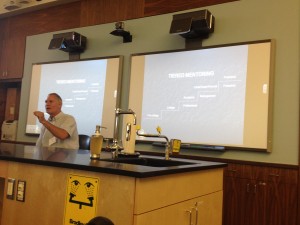
Through STEMAbilities, I have the opportunity to help share my higher education experiences with other disabled students, so that they have an opportunity to go into the work force, as well. Mr. Conway even hypothesized that underrepresented groups inherently possess fundamental traits necessary to be successful in the STEM fields:problem solving skills, creativity, and persistence.
I don’t care what you’re doing, just go out there and do something – and help someone. Especially someone who could use your help.